
Let's Talk

Author: Orthoplex Solutions

  • The Ultimate Guide to Increase Nonprofit Website Engagement

    The Ultimate Guide to Increase Nonprofit Website Engagement

    Having a beautiful and well-designed website is a very good start for your nonprofit organization’s online presence and credibility. But, is this enough? Unless your audience engages with you and stays on your website for a long time to learn about your cause and mission, you might miss out on tons of opportunities. So, does your nonprofit organization’s website get enough engagement from your followers or potential donors? If not, it may be missing some crucial elements that help any nonprofit organization get the results expected from its website. In this article, you’ll discover the 10 key elements you can immediately apply to your website and get rapid and remarkable improvement in your website engagement. Not only this, you will start building a stronger community for your organization and have a deeper impact on the people you serve.

    But first,

    Why does your nonprofit need a well-designed and engaging website?

    Share your Story

    Whether you’re a small local charity or a large international organization, a well-designed website boosts your visibility, making it easier for people to discover your story and learn about your mission and initiatives.

    Manage Fundraising & Donations

    Your website can be your primary channel for fundraising by implementing payment gateways such as PayPal, Stripe, and many more.

    Communicate with your audience

    A website can also be the best channel for communicating your cause, values, milestones, impact, announcements, updates, and important information with supporters constantly, keeping you on top of the minds of your followers and supporters.

    Although you might be using many other channels to communicate with your audience like; email newsletters, social media posts, podcasts, ads, or even offline promotional campaigns, your website remains the main source of information for anyone who would want to connect with your organization.

    That’s why investing time and effort to maximize your nonprofit organization’s website engagement is always worth it.

    Manage the volunteering and hiring process

    Also, your website can streamline the volunteering and hiring processes and promote your events. Normally, these multi-step processes are overwhelming, repetitive and consume a lot of time. Instead of starting your hiring process from scratch every single time, you can implement a convenient hiring tool that helps you automate these tasks.

    Manage all events in one place

    For event management, you can manage all your events directly from your website in one of two ways:

    • Using a WordPress plugin such as EventON.
    • Embedding an external tool such as EventBrite and embedding it on your site.

    Share reports and achievements

    Your website also can be your main tool to demonstrate your accountability by providing information about the organization’s finances, results, and how donations are used.

    Finally, one key point to always keep in mind; your website has unlimited possibilities that you can leverage once you need them. Because you are always in control of what to show to your audience, and how to present your content in a way that aligns with your brand theme and identity.

    Also, your website can integrate seamlessly with whatever internal systems you use to organize and manage your data like your CRM, email management software, social media platform, etc. Plus, you can always streamline and automate any portal on your website to save time and money for other priorities.

    With that said, If you want to turn your website from just a beautiful website for your nonprofit organization into your organization’s success catalyst, you need to start maximizing its engagement.

    The good news is, it’s not that hard. You just need to start implementing the best practices for nonprofit website engagement and you’ll reap unbelievable results.

    Now, let’s explore…

    The 10 essential engagement elements every nonprofit organization website should have to increase their engagement and impact

    Mission Statement: What is it? How to create one in a clear way?

    What’s a mission statement?
    Your mission statement is a statement that describes your purpose, who you serve, and your mission and the goals you aim to achieve.

    Your mission statement is the heart of your nonprofit website engagement. It should be prominently displayed on your website’s homepage to clearly articulate your purpose, mission, who you serve, and goals concisely. Note that its design should be clear, using your brand fonts and theme.

    A great example of how to integrate your mission statement in your message is Ten Tree. This closing brand does a fantastic job serving our planet through planting 10 trees with every single purchase.

    They effectively integrate their mission statement, “Planting trees with every purchase,” into their brand identity and marketing strategies, emphasizing environmental sustainability and social responsibility.

    Your nonprofit organization can follow their lead by aligning your mission with tangible actions, integrating it into your branding and communication efforts. This will keep your stakeholders engaged in your mission, and build trust and loyalty with your website visitors.

    So, how to write your mission statement for your nonprofit organization?

    We will give you a simple formula:

    We (Your nonprofit organization’s name) helps/empowers (the specific community you serve) to achieve/get (The outcome/transformation/results you help them achieve) through (Your unique mechanism to help them achieve these results).

    Now, where to properly implement your mission statement on your website?

    1. Homepage: The first strategic place you want to show your mission statement is on your home page, ideally at the top. This place ensures any visitor can immediately understand your nonprofit organization’s purpose, who you serve, and how.

    2. About us page: Your about us page is the second most important page on your website after your homepage. It’s where people go to start trusting you and feel safe to volunteer or support your cause. It’s crucial to have your mission statement shown clearly on your About us page.

    3. Donation and Volunteering pages: These pages are where people are taking actions that dramatically benefit your organization. So, showing your mission statement on these pages can help them complete the process knowing that they are making a difference in the world.

    4. Website Footer: Finally, placing your mission statement in the footer can be very beneficial as visitors often scroll all the way down to find your social media accounts and your contact information. Placing your mission statement there increases the chance of your audience reading your mission statement.

    Compelling Storytelling: Your Secret Weapon to High Engagement
    All human beings are so attached to stories. In our childhood, we grew up listening to stories from our families. We learn morals through stories. In schools, we learn our history through stories. We even love to hear the stories behind any scientific discovery or theory. These stories are so wired to our nervous system. And we have so much attachment to them.

    The same principles apply to any brand or organization that needs to stick to the mind of its audience.

    Stories have the power to inspire and connect with people on a deeper emotional level more than anything else. And we all know that actions are inspired by emotions in the first place.

    So, to get more volunteers, more donors, and more supporters, you should leverage the power of your stories.

    But what kind of stories should you share?

    Share real-life examples of families or individuals you helped, written and video testimonials, and case studies to illustrate the impact of your work and the lives you’ve touched.

    How many stories do you need to share as a start?

    On your home page, you need to share at least three stories, or links to them, because sharing one may be an odd case, two can be a coincidence, but three, you’ve just proven it!

    However, you need to obtain written consent before sharing any individuals’ stories on your website.
    This shows you respect their privacy, comply with legal regulations, and mitigate liability risks.

    This practice fosters transparency and trust, allowing individuals to control how their stories are shared by your organization.

    Where on your website should you place your stories?

    We dare to say, everywhere!
    On your homepage, your about us page, your donation page, your volunteering and careers pages, your services… etc.

    Call-to-Action Buttons: They Are More Than Just Buttons!

    One of the biggest mistakes we notice while developing nonprofit websites at Orthoplex Solutions is unclear CTA [Call To Action].

    Strategically placing clear call-to-action buttons throughout your website helps guide your visitors toward taking the action you want at the proper time. Whether it’s donating, volunteering, or subscribing to your newsletter, make it easy for visitors to get involved.

    According to Neil Patel you should place your CTAs properly without being spammy so Google doesn’t downrank your webpage. So, ensure your CTAs are visible and stand out with contrasting colors. Place them naturally within the content flow, and match them to the page’s context.

    Also, it’s crucial to use action-oriented language, and regularly perform A/B testing to optimize your CTAs performance and know which one drives the highest engagement.

    User-Friendly and Secure Donation Process: How to Leverage it to Boost Engagement

    Fundraising and donations can be the backbone for your nonprofit organization’s income that supports your cause, funds your operations costs, community activities, and marketing campaigns.

    So, when you simplify the donation process on your nonprofit website, this encourages more supporters to contribute to your cause.

    But this won’t be effective without implementing a secure and intuitive online donation system with multiple payment options and providing transparency on how donations are used.

    There are a lot of factors to consider when it comes to selecting the best donation tool for your website such as:

    1. Security:
      You must ensure the tool you choose has strong security measures and comply with the industry standards.

    2. Flexibility:
      Your audience uses many payment methods, so you need to choose a tool that supports various and popular payment methods.

    3. User Experience:
      Make sure the donation platform you choose provides a simple and straightforward interface with a few steps to make it easy for donors to complete their donations.

    4. Integration:
      The best donation management platforms in the market provide integration features so you can automate the donation process and connect its data with your CMS.

    5. Cost:
      All donation platforms come with upfront and ongoing costs. Make sure to consider these ongoing subscription costs, especially as you scale and grow your organization.

    One of the most amazing tools we implement for our clients is Bloomerang.

    This tool can streamline and improve donation processes for nonprofits by providing a user-friendly donation interface with various payment options, enabling easy setup of recurring donations, and integrating with CRM systems.

    It also provides advanced security measures to ensure donor data protection. This tool improves the donor’s experience and the overall donation process.

    Check our detailed blog [The Best Donation Platforms for Nonprofit Organizations in 2024] to learn how to choose, implement, and monetize the best donation platform for your nonprofit organization.

    Transparency: Your Key to Building Trust

    Transparency is one of the most important keys for volunteers and supporters to stand for your nonprofit organization. So, being transparent about your organization’s finances, impact, and accomplishments on your nonprofit organization website builds impeccable trust and enhances your nonprofit website engagement.

    Be consistent with sharing your organization’s financial reports, milestones, and updates to demonstrate accountability and credibility.

    We see almost all our nonprofit clients like TFO and HOPA Ports publish their reports regularly every quarter or six months at most. In these reports, they share financial information, program updates, future program plans, key performance indicators, and fundraising outcomes.

    This transparency in financial health, impact metrics, and donor contributions builds trust and credibility with their audience and dramatically increases their website engagement.

    So, where on your website and how should you publish the reports of your nonprofit organization?

    The best practice is to have a dedicated “Reports Page” where you make all your reports easily accessible.
    You can use a popup on your homepage notifying your visitors about the release of your most recent report.

    If you have a large email list and social media following, you can invite your followers to visit your website to check the latest reports.

    By making these reports available you significantly increase your trust and engagement with stakeholders.

    Engaging Visual Content: This is How to Captivate Your Audience

    People remember what they see more than what they read or hear. To stay on top of the minds of your audiences and consistently get them engaged with you, you need to convey your message effectively through compelling visual content on your nonprofit organization website.

    Make sure to use high-quality images, videos, and infographics to tell your story, demonstrate your impact, and connect with them on a deeper emotional level that boosts your engagement. Let’s look at the restaurants and malls industry as an example: many businesses are using engaging visual content to maximize their engagement with their audiences and scale their brands. Here’s one of the most trending and amazing engagement tools they use, Mapplic.

    Mapplic is a highly versatile and interactive map plugin that you can apply to your website. It allows users to transform simple images and vector graphics into dynamic, responsive, and fully interactive maps. It’s a top choice for various clients to boost their nonprofit website engagement.

    Interactive Features: Take Your Engagement to The Next Level

    With the short attention span of anyone who uses the internet, you cannot rely on a passive way of communication. When you build an interactive website for your nonprofit organization and engage your audience by incorporating features such as quizzes, polls, and interactive maps, you dramatically increase your nonprofit website engagement and empower your brand.

    Put these interactive elements on multiple pages on your website and encourage visitors to actively participate and explore your website further.

    One of the most engaging features to date is adding a chatbot to your website. When we added an AI-empowered ChatBot to our own website, our engagement skyrocketed! Recently, our company started providing ChatBot implementation as a new service to our clients and the feedback has been amazing!

    The ChatBot helped their visitors find exactly what they are looking for in a matter of seconds, instead of navigating the whole website for one piece of info!

    Another interactive tool you can implement is Videoask. This tool allows you to create an interactive video experience for your visitors where they watch your video then reply to it.

    Here are a few examples on how to use Videoask to increase the engagement of your nonprofit website:

    1. Personalized Welcome Message:
      You can use VideoAsk to welcome visitors with a personalized message. Maybe from your brand ambassador or the executive director, explaining your mission and encouraging them to explore your website.

    2. Donor Engagement:
      You can Embed a video message on your donation page to explain the donation options, direct them through the process, and also show them how their donations make a difference.

    3. Volunteer Recruitment:
      Use VideoAsk to showcase volunteer opportunities and how they can get involved and what to expect.

      Make sure to test any tool you choose to use to ensure that it works reliably and that it does not have any negative effect on the performance or speed of your website.

    Social Proof: Your Ultimate Approach to Building Unshakeable Trust and Drive Engagement

    What’s more powerful to build trust than social proof?

    Absolutely nothing.

    Focusing on showcasing endorsements, testimonials, and success stories from donors, volunteers, and beneficiaries is the best way to build credibility and inspire trust for your nonprofit organization’s website.

    Social proof can reassure visitors that their support will make a meaningful difference and they are not wasting time or money by supporting you.
    What kind of social proofs can support you most?

    Awards

    One of the most credible sources to gain a robust social proof, and exposure as well, is to succeed in having awards from reputable sources.

    According to the National Council of Nonprofits, receiving awards from reputable sources can significantly benefit your nonprofit by enhancing credibility, increasing your visibility, expanding your networks, and facilitating fundraising efforts.

    Leveraging these awards effectively by sharing it on your website can amplify your organization’s impact, attract more support, and significantly increase your website engagement as more and more people gain instant trust in your organization.

    Case studies

    Detailed case studies showcasing your impact is one of the most robust social proof techniques.
    So, wherever you have a great success story, document it, and convert it into a case study.

    What to include in these case studies?

    Ideally, you will need at least three parts.

    A. The status quo: Here you draw a vivid picture of the situation of the community or people you serve before your organization’s intervention.

    B. The unique solution: In this part, you need to illustrate your efforts, mechanisms, and procedures undergone to fix the existing problems.

    C. The transformation: Finally, by using stats and numbers, you need to explain the results of your solutions. Like how many people were served? How many units were provided? How many donations were made? etc…

    Media and press Coverage

    Featuring positive media coverage and articles published about your nonprofit on your website can dramatically boost your credibility.

    You can achieve great media and press coverage by having your own PR team or an external partner.

    A dedicated PR team can help you with valuable resources that you can publish on your website:

    A. Press Coverage: They can help you to get featured in online publications, online podcasts, national newspapers and magazines.

    B. Influencer Campaigns: They can collaborate with local influencers to create content about your nonprofit’s mission and impact. And you can share this content prominently on your website.

    C. Event Publicity: They can convert a regular event to a marvelous experience for your community. They can get you sponsors and fundraisers. Plus they can create post event highlights, including media coverage, on your website.

    Mobile Optimization: This Can Make All The Difference

    According to MobiLoud, 58.21% of website traffic globally comes from mobile devices. Ignoring the UX,user experience, may hinder half of your online effort! It’s essential to ensure your website is mobile-friendly, and your visitors can have easy access to all that they need on your website.

    It’s also important to optimize your site for various screen sizes and devices to provide a seamless browsing experience for all visitors. That’s why at Orthoplex we use one of the best in class website builders, Elementor Pro.

    Elementor Pro gives us so much control over the website’s responsiveness. It allows us to easily create a clean and unique user experience on all device sizes to help visitors enjoy their time using your website or app while staying engaged.

    So, what to check with your web development company, post-development, to make sure your nonprofit organization website is fully optimized?

    a. Responsive Design

    Your website must adapt dynamically with different screen sizes and work seamlessly on any internet browser.

    b. Page Load Speed

    According to Google, most users expect a website to load in 3 seconds or less!

    So, if it takes longer for your website to load, they’re more likely to abandon it.

    You can monitor this by performing tests using simple, free tools like: Google PageSpeed Insights to test and optimize your page load times for web and mobile devices.

    Also, consider optimizing your images and media by compressing them to ensure quick loading without reducing their quality.

    c. Content Readability

    Make sure to use proper font sizes and spacing so text is readable without needing to zoom in, with adequate spacing between lines and paragraphs.

    Content Layout: To improve readability, avoid long paragraphs. Use headings and bullet points.

    d. Mobile-friendly Forms

    Simplified Forms: Ensure your forms are easy to fill out on mobile devices using large input fields and minimal required information.

    Test Donation Forms: Check the entire donation process on mobile to ensure that it is simple and functions properly. So you don’t miss any potential donors.

    e. Usability Testing

    Real Device Testing: Test your website on various mobile devices and browsers to detect and solve any issues.

    User Testing: It’s really useful to get direct feedback from actual users to detect usability issues and areas for improvement.

    f. Navigation and User Interface (UI)

    Easy Navigation: Ensure that menus are easy to access and use, with a clear structure and labels.

    Sticky Navigation Bars: Using sticky navigation bars is a simple way to keep essential links accessible to users as they scroll.

    g. Call to Action (CTA) Optimization

    Prominent CTAs: Make sure CTAs are easily seen and clickable on mobile screens.

    Clear and Concise: Use clear, action-oriented words for CTAs to encourage users to engage.

    Regular Website Content Updates: The Most Overlooked Engagement Strategy

    Keeping your website content fresh and relevant is key to increasing engagement and building trust. Not only this, according to MOZ, the freshness of your content is key to improving your Google ranking, increasing your customers’ engagement, and building trust and credibility for your organization.
    You can do so by creating a long-term content and publishing plan for your website and regularly updating it with blog posts, news articles, and event announcements.

    Also, it’s important to stay active on all other online platforms like Google My Business, newsletters, and your social media accounts. This shows that your organization is active and engaged in its mission, and encourages visitors to return for the latest updates.
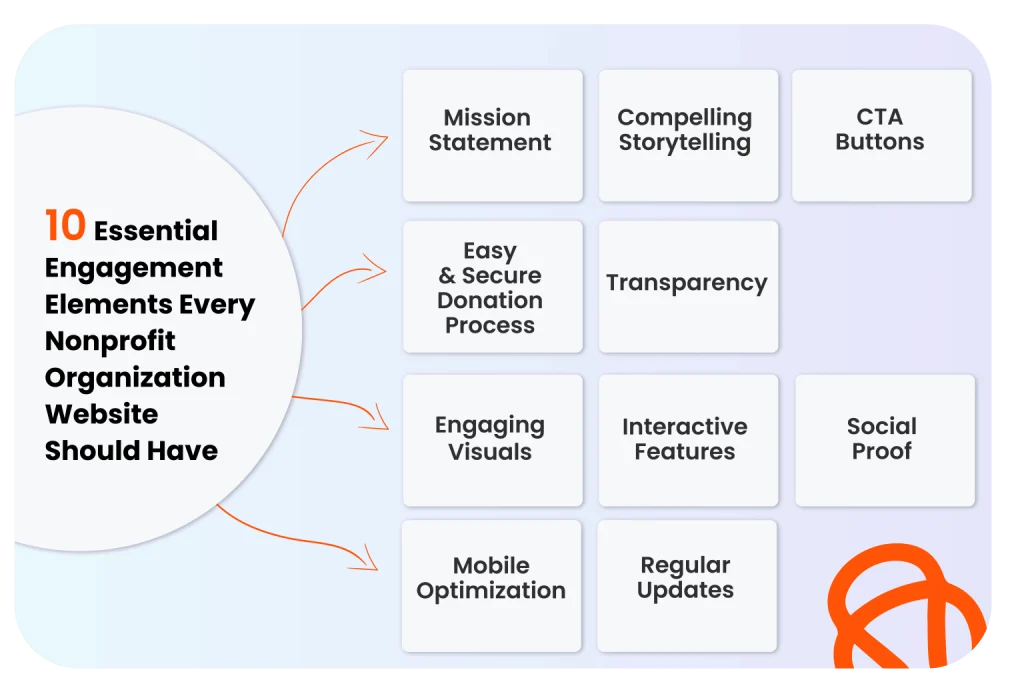
    By incorporating these 10 essential engagement elements into your nonprofit organization’s website, you can effectively connect with your audience, inspire action, and make a positive impact in your community and beyond.

  • Orthoplex Solutions Launched The World’s First Free Online Toy Store for children, Dayra.ca!

    Orthoplex Solutions Launched The World’s First Free Online Toy Store for children, Dayra.ca!

    Toronto, Canada – 02 April 2024 – Orthoplex Solutions, a Canadian software development company founded in 2015, is proud to announce the launch of Dayra.ca. Dayra is the world’s first free online toy store for children in Canada and the USA, dedicated to introducing children to the wonders of technology.

    How it All Started

    The idea for Dayra.ca sprouted from a deeply personal place for the Orthoplex Solutions founders, three siblings who grew up witnessing the power of generosity firsthand. As children, they regularly accompanied their mother on visits to orphanages, sharing gifts and creating lasting memories with those children. This instilled in them a profound desire to replicate that impactful giving on a larger scale, paving the way for Dayra’s creation years later.

    Addressing a Growing Need in North America

    The Orthoplex Solutions founders recognize the financial struggle faced by many families in North America. Dayra allows families to experience the thrill of online shopping and witness the joy it brings to their children.

    A Simple Idea with a Significant Impact

    Dayra operates on a straightforward yet impactful concept. Vouchers are distributed to parents who are registered with foodbanks across Canada and the United States, granting them the ability to purchase a gift through the website. The Foodbanks’ established networks and shared commitment to serving their communities ensure that Dayra reaches families who will truly benefit from this initiative.

    The store releases new toys several times a year, allowing families to choose a special gift during designated product release windows. This approach allows for an equal opportunity to all participants and prevents misuse, maximizing the initiative’s impact.

    Dayra.ca the world's first free online toy store for children in Canada and the USA

    Figure 1: All parents registered with the Dayra partner foodbanks receive a voucher with a unique number. This number is used on the website during checkout to allow parents to purchase one gift per child.

    Beyond Business, a Ripple Effect of Kindness

    The positive impact of Dayra extends far beyond the initial act of giving. Witnessing the overwhelming response from existing clients eager to contribute and new customers drawn to the initiative’s purpose has been a heartwarming experience for the Orthoplex Solutions team. 

    Empowering Children, One Toy at a Time

    Dayra is dedicated to reaching as many children as possible across Canada and the United States. The initiative’s long-term goal is not only to spark joy, but to foster a love for technology in young minds. By introducing them to the wonders of the digital world, Dayra hopes to empower children and unlock their potential for future exploration and innovation.

    Dayra.ca the world's first free online toy store for children in Canada and the USA

    Figure 2: Dayra accompanies each gift with an inspirational message, aiming to uplift and inspire the children receiving them.

    Contribute to our cause

    We invite you to learn more about Dayra.ca, the world’s first free online toy store for children in Canada and USA and explore how you can contribute to its mission of bridging the digital divide and bringing joy to children.

    Together, let’s create a world where every child has the opportunity to experience the magic of technology and the excitement of online shopping.

  • Essential SEO Tips for Website Optimization

    Essential SEO Tips for Website Optimization

    In today’s digital age, having a strong online presence is crucial for any business. Search Engine Optimization (SEO) plays a pivotal role in ensuring your website is discoverable and ranks well on search engines like Google & Bing. In this tutorial, we’ll discuss the essential SEO Tips for Website Optimization and provide actionable steps to ensure your site meets SEO basics.

    1. Understanding the Importance of SEO:

    Before diving into the specifics, let’s grasp why SEO matters. SEO enhances your website’s visibility, drives organic traffic, and boosts its credibility. A well-optimized site is more likely to appear in search results when users search for relevant keywords.

    2. Keyword Research:

    Identifying the right keywords is the foundation of successful SEO. Start by researching keywords that are relevant to your business and have a substantial search volume. Tools like Google Keyword Planner and SEMrush can assist you in this process.

    3. On-Page SEO:

    Optimizing individual pages is essential. Here’s what you need to focus on:

    – Title Tag: Craft descriptive, keyword-rich title tags for each page.

    – Meta Description: Write compelling meta descriptions that encourage clicks.

    – Header Tags (H1, H2, H3): Use header tags to structure your content and incorporate keywords naturally.

    – Keyword Placement: Strategically include keywords in your content, URLs, and image alt text.

    4. Quality Content Creation:

    High-quality content not only engages users but also attracts backlinks and shares. Create informative, relevant, and valuable content that addresses your audience’s needs and concerns.

    5. Mobile-Friendly Design:

    With the majority of users accessing the internet via mobile devices, having a responsive and mobile-friendly design is vital for SEO. Google prioritizes mobile-friendly websites in its rankings.

    6. Page Loading Speed:

    Slow-loading pages can lead to high bounce rates and lower rankings. Compress images, use browser caching, and optimize your website’s code to improve loading speed.

    7. Technical SEO:

    Ensure your website’s technical aspects are in order:

    – XML Sitemap: Submit an XML sitemap to search engines to help them index your pages.

    – Robots.txt: Use a robots.txt file to guide search engines on which pages to crawl and which to avoid.

    – Canonical Tags: Implement canonical tags to prevent duplicate content issues.

    8. Backlink Building:

    Building high-quality backlinks from reputable websites enhances your site’s authority and credibility. Focus on creating shareable content and reaching out to relevant influencers or websites for guest posting opportunities.

    9. Monitoring and Analytics:

    Regularly monitor your website’s performance using tools like Google Analytics and Google Search Console. These tools provide insights into your site’s traffic, rankings, and areas for improvement.

    Take-away:

    Mastering the basics of SEO is essential for positioning your website for success in the competitive online landscape. By understanding the importance of SEO, conducting thorough keyword research, optimizing on-page elements, creating quality content, and addressing technical aspects, you can ensure your site meets the essential SEO tips for website optimization and attracts organic traffic.

    Remember, SEO is an ongoing process, and staying up-to-date with the latest industry trends and algorithm changes will help you maintain and improve your website’s search engine rankings over time.

    ________

    #webdevelopment #seo #design

    A portion of this article was generated with the help of OpenAI’s ChatGPT.

    Image licensed from Envato Elements.

  • The Power of WordPress Elementor integration

    The Power of WordPress Elementor integration

    In the ever-evolving digital landscape, having a compelling online presence is essential for individuals and businesses alike. When it comes to building dynamic and user-friendly websites, WordPress and Elementor stand tall among the vast sea of content management systems and website builders. In this article, we’ll delve into the power of WordPress Elementor integration, focusing on the flexibility of template kits, speed optimization with WP Rocket, and the ability to build anything using Custom Post Types (CPTs).

    Flexibility with Template Kits

    Gone are the days of struggling with rigid website templates that limit your creative freedom. WordPress, when coupled with Elementor’s template kits, empowers users with unmatched flexibility in website design. Template kits provide a vast array of professionally designed templates, including headers, footers, and various sections, that can be easily customized and mixed to create a unique and stunning website.

    With Elementor’s intuitive drag-and-drop interface, you can effortlessly modify each element, personalize colors, fonts, and layouts, and add your brand identity throughout the site. Whether you’re a seasoned web developer or a beginner, the power of template kits ensures that you can create a visually appealing and cohesive website that resonates with your target audience.

    Page Speed with WP Rocket

    In the digital age, speed is king. Slow-loading websites can lead to frustrated visitors and higher bounce rates. WordPress, when integrated with the WP Rocket plugin, addresses this issue head-on. WP Rocket is a robust caching and optimization plugin that works seamlessly with WordPress and Elementor to enhance the loading times of your website.

    By caching pages, compressing files, and optimizing images and scripts, WP Rocket significantly improves the overall performance of your site. The result? Blazing-fast page loading times, a seamless user experience, and a higher likelihood of retaining and engaging your visitors.

    Building Anything with CPT

    WordPress is no longer just a blogging platform; it has evolved into a versatile content management system. With the ability to create Custom Post Types (CPTs), you can take your website’s functionality to the next level, turning it into a platform. Whether you need to showcase portfolios, testimonials, events, products, or any other type of content, CPTs allow you to build anything your heart desires.

    Elementor’s seamless integration with CPTs enables you to design and display these custom content types with ease. You can create dynamic and personalized layouts for different CPTs, offering a tailor-made experience for your visitors and showcasing your content in the most captivating way. Here is a detailed overview for how CPTs work.

    Conclusion

    The Power of WordPress Elementor integration, is a game-changer for website development, offering unparalleled advantages over other platforms or builders. The flexibility provided by template kits allows you to craft a visually stunning and unique website without the hassle of coding. When optimized with WP Rocket, your site gains a significant speed boost, delivering an exceptional user experience.

    Moreover, the ability to build anything using Custom Post Types opens up endless possibilities for content organization and presentation. Embracing WordPress and Elementor’s capabilities will not only streamline your website development process but also elevate your online presence to new heights. So, seize the opportunity and harness the power of WordPress and Elementor for your next website project.

    #Wordpress #WebDevelopment #Elementor

  • AI Revolution in Project Management: Efficiency Unleashed

    AI Revolution in Project Management: Efficiency Unleashed

    In the rapidly evolving landscape of project management, traditional approaches are giving way to groundbreaking technologies that are reshaping the way teams work together. At the forefront of this transformation is Artificial Intelligence (AI), a game-changing force that has the potential to revolutionize project management practices.

    Artificial intelligence is not a substitute for human intelligence; it is a tool to amplify human creativity and ingenuity – Fei-Fei Li

    Leaps of AI in Project Management

    By leveraging AI-driven tools and algorithms, project managers can unlock unprecedented levels of efficiency, collaboration, and achievements. In this article, I will discuss how AI is reshaping project management, highlighting its role in enhancing productivity and driving successful outcomes.

    1. Streamlining Task Allocation and Scheduling: One of the core challenges in project management is optimizing task allocation and scheduling to ensure that every team member’s skills are effectively utilized. AI-driven project management tools analyze historical data, team performance, and resource availability to allocate tasks more efficiently. With these insights, managers can assign the right tasks to the right individuals, leading to improved productivity and reduced project completion times.
    2. Enhancing Decision-Making with Data-Driven Insights: AI’s ability to process and analyze vast amounts of data enables project managers to make well-informed decisions. From forecasting potential roadblocks to identifying trends and patterns in project progress, AI-powered analytics provide valuable insights for agile decision-making. This data-driven approach empowers managers to proactively address issues and capitalize on opportunities, ultimately leading to better project outcomes.
    3. Improving Risk Management: Every project entails risks, but identifying and mitigating them in real-time is crucial for success. AI algorithms excel at risk prediction by analyzing historical project data, industry trends, and external factors. By proactively identifying potential risks, project managers can implement risk-mitigating measures, ensuring smoother project execution and minimizing unexpected disruptions.
    4. Forecasting Resource and Budget Allocation: Accurate resource and budget allocation are crucial for project success. AI-powered tools can predict future resource requirements based on historical data, team productivity, and project complexity. By anticipating resource needs, project managers can optimize budget allocation and avoid over- or under-allocating resources, leading to cost-effective and streamlined projects.

    My Tool of Choice

    In my journey to discover the most effective project management solution, ClickUp has emerged as my tool of choice, revolutionizing the way I manage projects with its exceptional AI capabilities. By incorporating ClickUp’s AI-driven tools into my workflow, I have experienced unparalleled efficiency in task allocation and scheduling. The smart task assignment feature considers team member skills and availability, ensuring that each individual contributes optimally to the project’s success. Moreover, ClickUp’s data-driven insights have been a game-changer for my decision-making process. With real-time performance metrics and predictive analytics, I can make well-informed choices, setting precise project timelines and allocating resources effectively.

    With ClickUp’s remarkable AI capabilities, my project management journey has been transformed for the better. It has become an indispensable tool that streamlines my team’s workflows, enhances collaboration, and ensures success in every endeavor. If you’d like to experience the transformative power of ClickUp’s AI-driven project management firsthand, feel free to check it out through my referral link. Together, we can embark on a journey of unprecedented efficiency and achievement in project management.

    Conclusion

    Amidst the unfolding AI revolution, project management takes center stage in this transformative era. A pivotal aspect of this change is selecting the right tools to support and maximize its potential. The integration of AI-driven technologies promises to unlock unparalleled efficiency and productivity in project execution. From streamlining task allocation to providing data-driven insights, enhancing risk management, fostering seamless collaboration, personalizing experiences, and optimizing resource allocation, AI empowers project managers to attain remarkable levels of success. Embracing AI in project management is more than just a choice; it is a decisive and essential step towards building future-ready and thriving projects.

    A portion of this article was generated with the help of OpenAI’s ChatGPT.

    Image licensed from Envato Elements.

  • Ethical Considerations in AI [Real-World Examples]

    Ethical Considerations in AI [Real-World Examples]

    Artificial Intelligence (AI) is rapidly transforming various aspects of our lives, presenting vast opportunities and unprecedented challenges. As AI continues to advance, it is becoming crucial to discuss the ethical considerations in AI that arise from its widespread adoption and its potential harms. I aim to explore some of the key ethical dimensions of AI, shedding light on the need for responsible development and deployment of this powerful technology.

    1 – Ensuring Transparency and Accountability:

    One crucial ethical consideration is the need for transparency in AI systems. For example, in the context of algorithmic decision-making in loan approvals, financial institutions should provide clear explanations to applicants about the factors that influenced the decision. This transparency fosters trust and enables individuals to understand and challenge decisions when necessary.

    2 – Addressing Bias and Fairness:

    AI systems trained on biased data can perpetuate and amplify existing biases. For instance, in the recruitment process, if historical hiring data contains gender bias, an AI-powered hiring system might inadvertently discriminate against certain applicants. Therefore, organizations must actively assess and mitigate bias, regularly audit algorithms, and ensure fairness throughout the entire hiring process.

    One specific example of the use of algorithmic decision-making in the criminal justice system is the COMPAS (Correctional Offender Management Profiling for Alternative Sanctions) system, which has been employed in some jurisdictions in the United States. COMPAS is designed to assess the risk of recidivism for defendants and provide judges with a risk score that can influence decisions related to pretrial detention, sentencing, or parole. Its purpose is to assist judges in making more informed decisions based on data analysis. However, the use of COMPAS and similar tools has sparked debates regarding transparency, fairness, and potential biases in the algorithm’s outputs, leading to discussions about the need for greater accountability and scrutiny in such systems.

    3 – Addressing Job Displacement and Workforce Changes:

    The rise of AI-driven automation has the potential to disrupt labor markets and lead to job displacement. For instance, the introduction of AI app development platforms such as Locofy.ai could impact the mobile app developers. To mitigate these challenges, proactive measures such as offering reskilling programs and facilitating the transition of affected workers into emerging industries can help ensure a just and equitable transition.

    4 – Promoting Ethical AI Research and Collaboration:

    To effectively address the ethical challenges of AI, collaboration among researchers, practitioners, policymakers, and ethicists is vital. An example of such collaboration is the Partnership on AI, an organization that brings together various stakeholders to develop best practices, share insights, and ensure the ethical development and deployment of AI technologies.

    Takeaway:

    As AI continues to evolve and integrate into our lives, we must recognize the ethical implications that arise alongside its immense potential.

    “Ethics must be an integral part of the design and deployment of artificial intelligence. We have the power to shape the development of AI technologies, ensuring they align with our values and serve the best interests of humanity.” – Sundar Pichai, CEO of Google

    Striving for transparency, fairness, privacy protection, and accountability should guide the responsible development and deployment of AI.  

    #ai  #robotics  #innovation

    ____________________

    A portion of this article was generated with the help of OpenAI’s ChatGPT.

    Image licensed from Envato Elements.

  • Safeguarding Your Online Presence: Practical Steps to Protect Your Digital Identity

    Safeguarding Your Online Presence: Practical Steps to Protect Your Digital Identity

    Did you catch the captivating HBO series “Silicon Valley“? Surely, many of you still vividly recall that thrilling twist when Gilfoyle, the tech genius, salvaged Pied Piper by skillfully hacking into Jian Yang’s smart fridge and leveraging its distributed network to save the company.

    Recently, you may have come across reports of a teenager claiming to have accidentally gained access to 25 Tesla vehicles. While the veracity of this claim remains uncertain, the mere thought of someone remotely accessing your car as you drive down the highway is undeniably unsettling.

    With such incidents of cyber intrusions taking place worldwide, even within large corporations, a pressing question arises:

    How can we protect ourselves and those around us from online threats and vulnerabilities?

    To unravel the complexities of this question, let me share some valuable lessons I’ve learned over time. These insights have become a constant recommendation for my friends and family, and I now extend them to you.

    1.Keep all your devices’ software up to date: Regularly updating your software, including operating systems and applications, is crucial. Developers frequently release patches and security updates to address vulnerabilities, so staying current is your first line of defense.

    2. Install a reliable firewall and antivirus: Invest in an affordable firewall and antivirus software to create an additional layer of protection against malicious attacks. These tools monitor incoming and outgoing network traffic, shielding your devices from unauthorized access. Microsoft offers several tools to simulate phishing attacks, assess risks and provide recommendations to improve your overall security.

    3. Educate yourself on phishing attacks: Familiarize yourself with the basics of phishing attacks, a common method employed by cybercriminals to trick unsuspecting users into revealing sensitive information. Learn to identify suspicious emails, messages, or websites and avoid clicking on unfamiliar links or sharing personal details.

    4. Strengthen passwords and monitor accounts: Adopt robust passwords for all your online accounts and change them regularly. Consider using a combination of letters, numbers, and symbols. Additionally, actively monitor your accounts for any unusual activity and report suspicious incidents immediately.

    Remember that it’s crucial to develop your own comprehensive security system tailored to your needs rather than blindly following others. Ignoring the importance of securing your online identity can have dire consequences.

    5. Embrace password managers: Utilize password management tools to securely store and generate strong, unique passwords for each of your online accounts. These tools alleviate the burden of remembering multiple passwords and enhance the overall security of your digital identity. I personally 1Password as my password manager app of choice. This tool securely stores and generates strong, unique passwords for each of your online accounts, alleviating the burden of remembering them all.

    6. Maintain hardcopy backups of your passwords: While digital password managers are highly secure, it’s prudent to keep a hardcopy backup of your passwords in a safe and confidential location. This ensures access to critical information in case of unforeseen circumstances.

    7. Enable 2 Factor Authentication (2FA): Whenever available, enable 2FA for all your accounts. This additional layer of security requires a secondary verification method, such as a text message or authentication app, to log in successfully. It significantly reduces the risk of unauthorized access. One highly recommended option is to use the Google Authenticator app, which provides an additional layer of security. Set up the app to receive authentication codes, with SMS or email serving as backup options in case of any issues with the app.

    8. Protect your SIM card: Safeguarding your SIM card is of utmost importance as it plays a pivotal role in your mobile connectivity and can be vulnerable to social attacks. In a scenario where someone gains unauthorized access to your phone and manages to steal your SIM card, they could potentially exploit it to bypass 2 Factor Authentication (2FA) security measures. This form of attack, known as SIM swapping or SIM hijacking, involves fraudsters tricking your mobile service provider into transferring your phone number to a SIM card under their control. With control over your phone number, they can intercept SMS-based verification codes or authentication requests, effectively bypassing the intended security measures.

    It’s crucial to understand that while 2FA using SMS-based codes can provide an additional layer of security, it is not foolproof. Being aware of the potential risks associated with SIM card vulnerabilities and taking proactive steps to protect yourself can help minimize the chances of falling victim to such social attacks.

    Lastly, I urge you to spread the word and lend support to your loved ones who may lack computer skills. By empowering them with these steps, we collectively contribute to a safer online environment.

    #OnlineSecurity #DigitalIdentityProtection #CyberSafety #StaySafeOnline

    References:

  • AI Empowering Robotics Development

    AI Empowering Robotics Development

    We all lived through the craze of OpenAI’s ChatGPT since its release in November 2022, and since then, it has become part of our daily lives. This is a proof that Artificial Intelligence (AI) is here to revolutionize all types of development, and profoundly robotics. By integrating AI technologies, robots can become more capable, intelligent, and efficient in performing complex tasks. I will explore with you through this short article real-world examples of how AI enhances the software development process, improves quality, and reduces accidents within robotics.

    Enhanced Software Development Process:

    AI has transformed the traditional development process by leveraging machine learning and deep learning techniques. Instead of relying on hardcoded rules, robots can learn from data and adapt their behavior. For instance, OpenAI’s Gym environment and Reinforcement Learning algorithms allow robots to learn tasks through trial and error. By repeatedly interacting with their environment and receiving feedback, robots can acquire new skills and refine their performance, enabling continuous improvement.

    As an example, OpenAI’s robotic system, Dactyl, learned to manipulate objects with remarkable dexterity using reinforcement learning. It initially started with random movements but quickly learned to grasp and flip objects accurately by learning from its mistakes. This iterative learning process showcases the power of AI in enhancing the software development cycle.

    Improved Quality and Reliability:

    AI plays a crucial role in enhancing the quality and reliability of robotics systems. By leveraging AI algorithms, robots can analyze data, make informed decisions, and perform tasks with greater precision and adaptability.

    As an example, Waymo, a leading autonomous driving company, utilizes AI and computer vision to navigate roads safely. Their self-driving cars analyze real-time sensor data from cameras, lidars, and radars, allowing them to detect objects, predict their behavior, and make informed decisions such as braking or changing lanes. With continuous learning and optimization, Waymo’s self-driving cars improve their driving skills over time, leading to increased safety and reliability on the roads.

    Accident Reduction and Safety:

    AI-driven robotics systems have the potential to significantly reduce accidents and enhance safety in various domains. Through advanced perception, planning, and decision-making capabilities, robots can actively avoid potential risks and operate safely in challenging environments.

    As an example, ABB, a prominent robotics company, has developed industrial robots equipped with AI-based collision avoidance systems, enabling them to work safely alongside human workers. These systems utilize computer vision and real-time monitoring to detect the presence of humans and adjust the robot’s movements accordingly to avoid collisions. By continuously analyzing sensor data, ABB’s latest collaborative robots can adapt their trajectory or halt their operation when necessary, effectively preventing accidents and fostering a safer working environment for human-robot collaboration.

    Conclusion:

    The integration of AI into robotics has ushered in a new era of possibilities, with tangible examples showcasing its impact. By enhancing the software development process through machine learning, robots can continuously learn and improve their performance. Improved quality and reliability are exemplified by self-driving cars, where AI enables precise decision-making and navigation. Furthermore, AI-driven accident reduction systems ensure safety in human-robot collaborative environments.

    Takeaway:

    As AI and robotics continue to advance, we can expect further breakthroughs in software development, quality enhancement, and accident reduction, empowering robots to become indispensable allies in various industries and augmenting our capabilities for a better future.

    Let us embrace this future and work towards unlocking the full potential of AI and robotics for a better tomorrow. #ai #robotics #innovation

    A portion of this article was generated with the help of OpenAI’s ChatGPT.

    Image licensed from Envato Elements.

  • The Power of a Strong Online Presence: Why Your Business Needs a Website

    The Power of a Strong Online Presence: Why Your Business Needs a Website

    A website is a necessary ingredient in today’s digital-driven business arena. It acts as your company’s virtual storefront, embodying your brand identity and values to the online world. With more and more consumers relying on the internet for their information, products, and services, having a robust online presence is crucial to attracting new customers and expanding your business.

    One of the paramount benefits of a website is amplified visibility and accessibility. A website creates a platform for your business to be discovered by potential customers who may not have otherwise known about you. Furthermore, a website provides a convenient way for customers to access information about your offerings, contact you, and make purchases at any time and from any location.

    Another critical aspect of having a website is enhancing credibility and trust with your customers. A polished, well-designed website projects that you are a dependable and trustworthy enterprise. It also affords customers the necessary information to make informed decisions regarding your products or services, which in turn can foster increased customer confidence and loyalty, as well as heighten customer satisfaction.

    A website also offers an opportunity for businesses to showcase their products or services in a visually compelling and interactive manner. With features such as high-quality images, videos, and interactive elements, a website allows businesses to narrate their unique story and highlight their value proposition to customers. This can distinguish your business from your competitors and pique customer interest.

    Another significant benefit of having a website is the capability to gather valuable customer data and insights. With tools such as analytics and tracking software, businesses can learn about their customers’ behavior and preferences and use this information to inform their marketing and business strategies. This can elevate the efficiency of your marketing initiatives, attract new customers, and ultimately drive increased sales.

    In conclusion, a website is an indispensable element of a successful business strategy. Whether you aim to reach new customers, establish credibility, showcase your products or services, or gather valuable insights, a website can help you achieve your objectives. With the appropriate design, content, and features, a website can propel your business towards greater success and growth.

  • Website Development for Non-Profit Organizations

    Website Development for Non-Profit Organizations

    Our company is dedicated to giving back to society and leaving a lasting positive impact. That’s why we’re wholeheartedly committed to website development for non-profit organizations.

    In this digital age, having a robust online presence is a must for all organizations, including those that are not-for-profit or community-based. These organizations often face constraints in terms of resources and finances, and may not possess the technical know-how to create a professional website on their own. This is where we come in. Our services empower these organizations to reach a wider audience, strengthen relationships with constituents, and achieve their objectives more efficiently.

    A well-designed website amplifies the visibility and credibility of not-for-profit and community organizations, and offers a platform to disseminate vital information and resources to stakeholders. Take, for instance, a website that doubles as an online hub for volunteer recruitment, fundraising drives, and community engagement. With a user-friendly interface and captivating content, these organizations can inspire active participation and support from their community.

    Orthoplex Solutions comprehends the peculiar difficulties faced by not-for-profit and community organizations. That’s why we strive to create tailored solutions that cater to their specific needs. Our team of seasoned developers, designers, and content specialists work closely with these organizations to understand their objectives, target audience, and messaging. The result? A website that effectively conveys their message and supports their cause.

    We’re cognizant of the fact that these organizations usually operate on limited budgets, and we aim to provide cost-effective solutions that don’t burden their finances. Our objective is to equip these organizations with the tools they need to thrive, without draining their resources.

    In conclusion, our company is fervently passionate about website development for non-profit organizations. We believe in the transformative power of technology and its ability to effect positive change. By providing these organizations with a strong online presence, we’re enabling them to connect with more people, build stronger relationships, and achieve their goals more effectively. And by working with us, these organizations can focus on what they do best – making the world a better place.