Understanding AI Agents for Business Automation
AI agents for business automation represent autonomous systems that independently plan, reason, and execute multi-step tasks without continuous human intervention. Unlike traditional rule-based automation or prompt-dependent generative AI, these systems maintain memory, adapt to changing conditions, and make context-aware decisions across complex workflows.
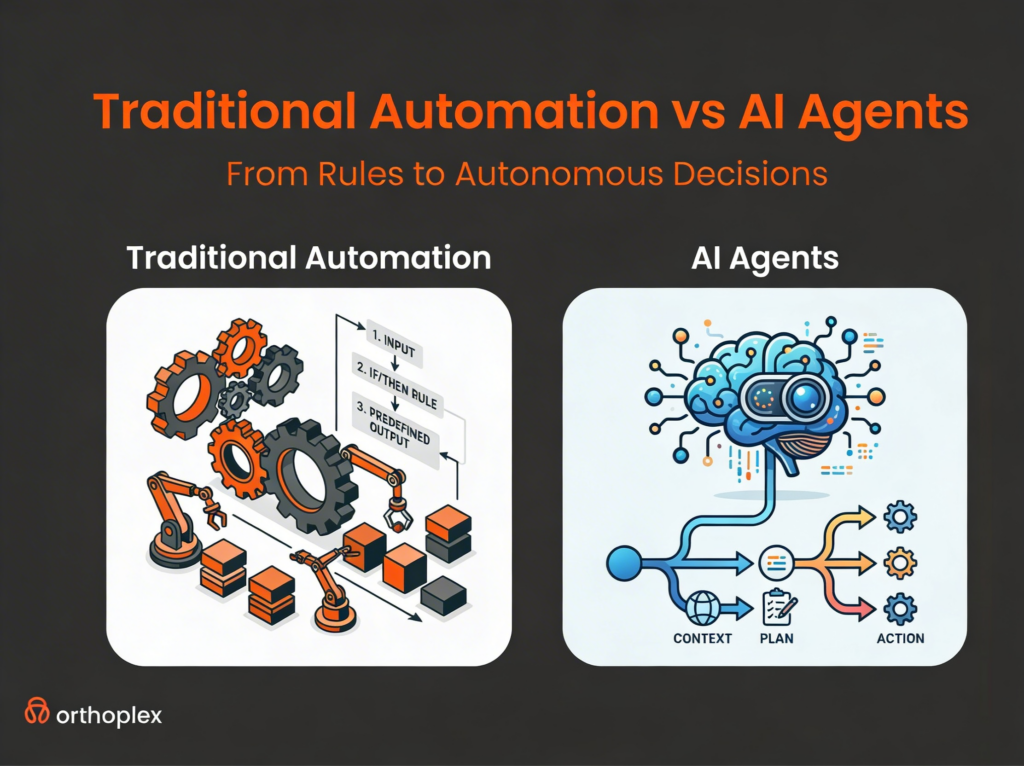
The distinction between AI agents and conventional automation lies in their cognitive architecture. Traditional automation follows predetermined logic paths. Generative AI responds to individual prompts. AI agents for business automation operate with goal-directed autonomy, using reasoning engines to decompose objectives into executable sub-tasks, invoke appropriate tools, and adjust strategies based on outcomes.
The global agentic AI market is projected to grow from $5.25 billion in 2024 to $199.05 billion by 2034, representing a compound annual growth rate of 43.84%. This expansion reflects fundamental shifts in how enterprises architect operational systems. Organizations no longer build static workflows. They deploy adaptive intelligence that scales decision-making capacity without proportional increases in human oversight.
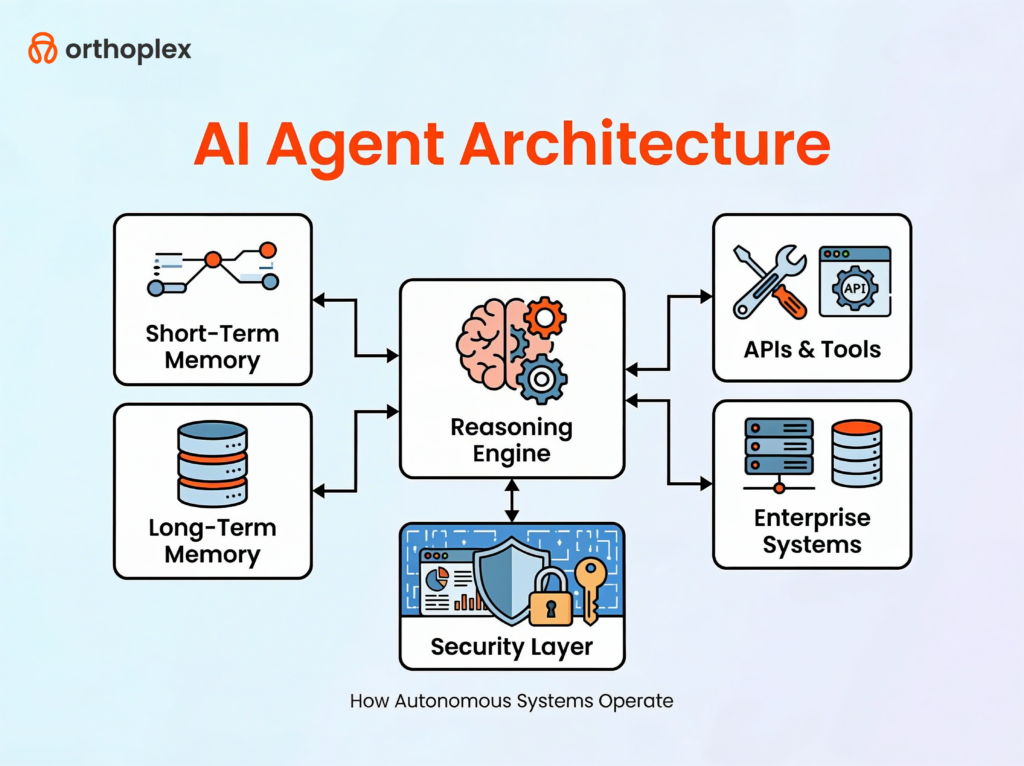
The technical foundation of AI agents for business automation combines large language models with specialized components. Reasoning engines process contextual information and determine optimal action sequences. Memory systems maintain both short-term context and long-term learning. Integration frameworks connect to enterprise systems through APIs. Security protocols enforce access control and maintain audit trails.
By 2028, 33% of enterprise software applications will incorporate agentic AI, up from less than 1% in 2024, enabling 15% of day-to-day work decisions to be made autonomously. This architectural shift means enterprise systems will evolve from passive data repositories to active decision engines. Software will not simply store information or respond to queries. It will initiate actions, coordinate across applications, and optimize processes without manual orchestration.
Market Adoption and Enterprise Deployment Patterns
According to a PwC 2025 survey of 1,000 U.S. business leaders, 79% of organizations report some level of AI agent adoption. This penetration rate signals that AI agents for business automation have transitioned from experimental technology to operational necessity. Among non-adopters, competitive pressure is mounting. Organizations that delay deployment face widening capability gaps as early adopters compress cycle times and reduce operational costs.
Deployment velocity varies by sector. Insurers moved from 8% full AI adoption in 2024 to 34% in 2025, a 325% increase. Finance and insurance lead adoption curves due to high-volume, rule-intensive operations where AI agents for business automation demonstrate immediate impact. Healthcare, manufacturing, and professional services follow similar trajectories as use cases mature and regulatory frameworks clarify.
52% of executives report their organizations have deployed AI agents in production, with 39% reporting deployment of more than 10 agents across their enterprise. Multi-agent deployments indicate organizations have moved beyond proof-of-concept projects. They are building agent ecosystems where specialized systems collaborate on complex workflows, each handling distinct sub-processes while sharing context and coordinating outputs.
The progression from pilot to production follows identifiable patterns. Organizations begin with single-function agents addressing well-defined processes. Customer service resolution, document processing, and data validation represent common entry points. Success at this level builds organizational confidence and technical capability.
65% of respondents said they have progressed from early experimentation into fully-fledged pilot AI agent programs, a significant jump from 37% in the previous quarter. This acceleration reflects maturing implementation methodologies and clearer understanding of technical requirements. Organizations that previously struggled with integration challenges now leverage established frameworks and reference architectures.
The most successful deployments focus on processes where autonomous decision-making creates immediate value. Inventory optimization, content personalization, and compliance monitoring provide clear ROI metrics. These use cases demonstrate that AI agents for business automation excel when combining judgment, context synthesis, and adaptive decision-making rather than simple repetitive tasks.
Financial Performance and Return on Investment
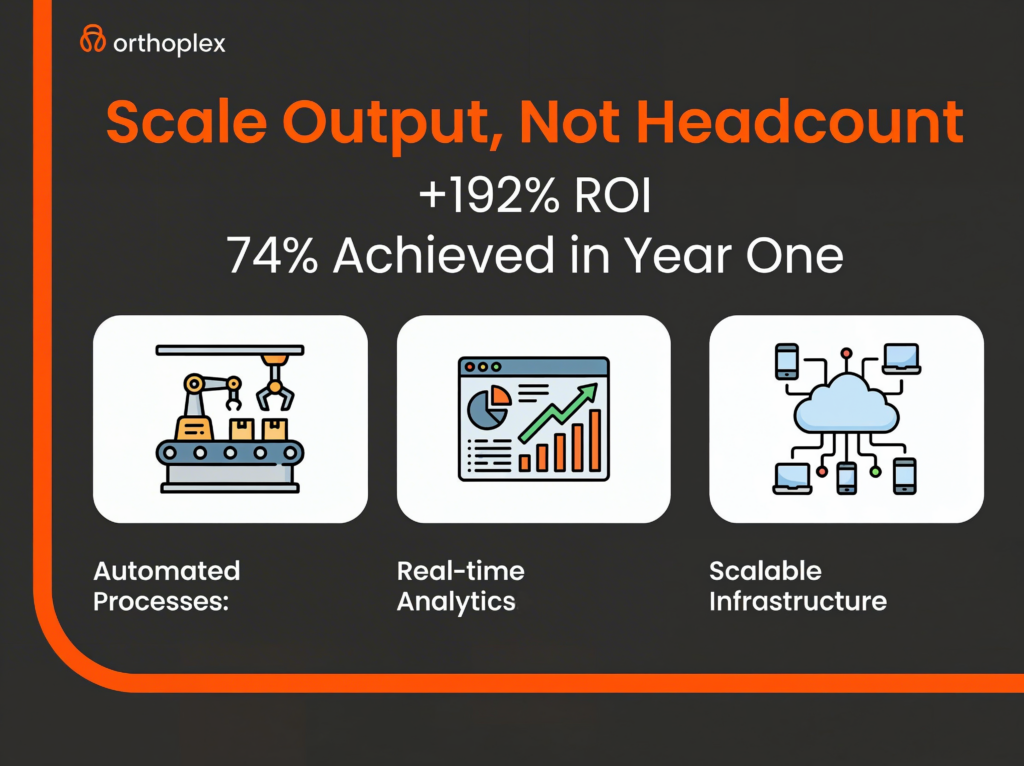
74% of executives report achieving ROI within the first year of AI agent deployment. This rapid payback period reflects the technology’s ability to automate high-value knowledge work rather than simple repetitive tasks. AI agents for business automation handle nuanced processes requiring judgment, context synthesis, and adaptive decision-making.
U.S. companies expect an average ROI of 192% from agentic AI implementations. These projections stem from proven generative AI returns. Organizations that achieved strong ROI on generative AI projects anticipate higher returns from autonomous agents due to reduced human-in-the-loop requirements and broader application scope.
Revenue impact extends beyond cost reduction. Among executives who report productivity gains in their organizations, 39% have seen productivity at least double. Growth comes from multiple vectors: accelerated product development cycles, enhanced customer service quality, optimized supply chain operations, and improved compliance adherence.
The financial impact calculation for AI agents for business automation requires comprehensive analysis. Direct cost savings include reduced manual processing hours. A typical implementation replacing 20 hours of manual processing per week at standard labor rates generates approximately $26,000 in annual savings per process automated.
Productivity gains manifest through faster cycle times and increased throughput. Organizations measure these improvements through process completion rates, error reduction percentages, and capacity increases without additional headcount. Deloitte’s 2024 AI survey reveals that 79% of companies using AI agents achieved ROI within 12 months, with average productivity gains of 35-50% across automated processes.
Strategic benefits include improved customer satisfaction, faster time-to-market, and enhanced compliance. These outcomes contribute to long-term business value that extends beyond immediate operational metrics. Organizations implementing AI agents for business automation report competitive advantages in market responsiveness and service quality differentiation.
The ROI formula for agentic systems accounts for implementation costs, platform fees, integration expenses, and ongoing operational costs. Organizations that measure comprehensive financial metrics achieve 23% higher ROI compared to those focusing only on efficiency metrics. This comprehensive approach captures both quantifiable savings and strategic business value.
Technical Architecture and System Requirements
AI agents for business automation require specific technical infrastructure. The architecture combines several critical components that work in concert to enable autonomous operation.
The reasoning engine serves as the cognitive core. This component processes natural language instructions, decomposes complex objectives into actionable sub-tasks, and determines optimal execution sequences. Advanced implementations use multi-step reasoning that evaluates multiple solution paths before selecting actions.
Memory systems maintain context across interactions. Short-term memory stores immediate conversation history and current task state. Long-term memory preserves learned behaviors, successful solution patterns, and domain-specific knowledge. This dual-memory architecture enables agents to improve performance through experience while maintaining awareness of immediate context.
Integration frameworks connect agents to enterprise systems. APIs provide standardized interfaces to databases, business applications, and external services. The Model Context Protocol has emerged as an industry standard for streamlining how agents access tools and data, simplifying integration and enabling rapid deployment.
Tool access mechanisms allow agents to invoke functions and services. These capabilities extend beyond data retrieval to include actions that modify system state, initiate workflows, and trigger notifications. Proper implementation requires careful security controls to prevent unauthorized system access.
Organizations implementing AI agents for business automation must ensure existing infrastructure can support autonomous operation. Network capacity, API rate limits, database performance, and authentication systems require evaluation. Many implementations require upgrades to handle increased API call volumes and real-time data access patterns.
Cloud platforms provide scalable infrastructure for agentic systems. AWS Cloud Management services enable organizations to provision compute resources dynamically, optimize costs, and maintain performance under variable workloads. Proper cloud architecture ensures agents operate reliably during peak demand periods.
CI/CD and Complete SDLC practices become essential for agent deployment. Continuous integration pipelines test agent behaviors against expected outcomes. Deployment automation enables rapid iteration and rollback capabilities when agents exhibit unintended behaviors.
Security Framework for Autonomous AI Systems
Security requirements for AI agents for business automation differ fundamentally from traditional application security. 80 percent of organizations say they have encountered risky behaviors from AI agents, including improper data exposure and access to systems without authorization.
The shift from human-mediated to autonomous operations introduces novel threat vectors. AI agents operate as “digital insiders” with varying privilege levels and system access. They can cause harm unintentionally through poor alignment or deliberately if compromised. This reality requires security frameworks specifically designed for autonomous systems.
Identity and access management forms the foundation. Every agent must be uniquely identifiable, authenticated, and bound to a verifiable trust anchor. Service accounts require cryptographic attestation and hardware-backed key storage. API keys and OAuth tokens must rotate automatically on defined schedules, typically every 24-72 hours.
Authorization mechanisms must evolve beyond static role-based access control. Context-aware, policy-driven access controls evaluate multiple factors before granting permissions. Agent behavior, requested resource sensitivity, time of day, and environmental conditions all inform authorization decisions.
File Integrity Monitoring and Vulnerability Monitoring services provide continuous oversight of agent operations. These systems detect anomalous behaviors, track file modifications, and identify potential security vulnerabilities before they can be exploited.
Behavioral analysis systems monitor agent actions in real-time. These controls detect when agents attempt unauthorized privilege escalation, access sensitive data outside normal patterns, or initiate actions inconsistent with their defined responsibilities. Anomaly detection algorithms flag deviations for immediate review.
Sandboxing and confinement strategies isolate agent execution environments. When agents process untrusted inputs or perform risky operations, isolation prevents potential compromise from affecting production systems. Formal verification methods provide provable assurances of safety in critical applications.
Governance processes ensure agents operate within acceptable boundaries. Organizations establish clear policies defining agent capabilities, approval workflows for expanding agent permissions, and escalation procedures when agents encounter situations outside their authority. These frameworks balance autonomy with control.
The Agentic AI Security Scoping Matrix provides a structured approach for understanding security requirements across different autonomy levels. Organizations assess their current use cases against four scopes: prompted assistance, delegated tasks, supervised autonomy, and full agency. Security controls scale proportionally with autonomy level.
Active Response capabilities automatically implement restrictions when agents exhibit concerning behaviors. Systems can inject tighter controls, require human approval for specific actions, or disable agents that negatively impact environments. These safety mechanisms prevent uncontrolled operations.
Implementation Strategy and Deployment Methodology
Successful implementation of AI agents for business automation follows progressive deployment patterns. Organizations that rush to full autonomy encounter operational challenges and security risks. Methodical approaches build capability while managing risk.
Initial assessment identifies automation opportunities. Process mapping reveals workflows suitable for agent automation based on task complexity, decision frequency, data availability, and regulatory constraints. High-impact processes with clear success metrics make ideal starting points.
Technical evaluation ensures infrastructure readiness. Teams assess API availability, data quality, integration requirements, and security controls. This analysis identifies necessary upgrades before agent deployment begins. Organizations working with software consulting experts achieve 40% faster assessment completion through comprehensive technical evaluation.
Pilot projects demonstrate agent capabilities in controlled environments. Limited-scope implementations validate technical approaches and business benefits before full-scale deployment. These pilots provide learning opportunities and help organizations refine governance frameworks.
The pilot phase typically focuses on single-function agents addressing well-defined processes. Customer inquiry routing, document classification, and data validation represent common pilot use cases. Success metrics include accuracy rates, processing times, and user satisfaction scores.
Integration with existing systems requires careful planning. Agents must connect to CRM platforms, ERP systems, and databases through secure APIs. 3rd Party API Integration expertise ensures reliable data exchange and proper error handling.
Gradual expansion extends successful automation patterns to similar processes. Organizations identify adjacent workflows that benefit from agent capabilities, leveraging lessons learned during pilot phases. This incremental approach maintains organizational confidence while building technical capability.
Multi-agent architectures emerge as organizations mature. Specialized agents collaborate on complex workflows, each handling distinct sub-processes while sharing context. Coordination mechanisms ensure agents work toward common objectives without conflicting actions.
Performance monitoring tracks agent effectiveness across multiple dimensions. Accuracy metrics measure how often agents make correct decisions. Efficiency metrics capture processing speed and resource utilization. Quality metrics assess impact on service delivery and customer satisfaction.
Continuous improvement processes refine agent behaviors based on operational data. Machine learning systems analyze successes and failures to enhance future decision-making. Regular model updates incorporate new insights while maintaining alignment with organizational objectives.
Application Server Monitoring provides visibility into agent resource consumption and performance characteristics. These insights inform capacity planning and help identify optimization opportunities.
Industry-Specific Applications and Use Cases
AI agents for business automation deliver value across diverse sectors, with implementation patterns varying by industry requirements.
Financial services organizations deploy agents for fraud detection, risk assessment, and customer service. Automated underwriting agents evaluate loan applications by analyzing credit histories, income verification, and risk factors. Customer service agents handle account inquiries, transaction disputes, and product recommendations with minimal human oversight.
Healthcare providers implement agents for appointment scheduling, patient triage, and clinical documentation. Ambient AI documentation systems reduce clinician burnout by automatically generating medical records from patient conversations. Insurance claims processing agents expedite validation and settlement procedures.
Manufacturing firms use agents for supply chain optimization, quality control, and predictive maintenance. Procurement agents automatically source materials, negotiate with vendors, and manage inventory levels. Production scheduling agents optimize factory operations based on demand forecasts and resource availability.
Retail organizations leverage agents for personalized customer engagement, inventory management, and dynamic pricing. Product recommendation agents analyze purchase histories and browsing behaviors to suggest relevant items. Customer support agents handle returns, track shipments, and resolve common issues autonomously.
Professional services firms deploy agents for document analysis, contract review, and compliance monitoring. Legal research agents analyze case law and regulatory requirements. Financial analysis agents process earnings reports and market data to generate investment recommendations.
Non-profit organizations benefit from AI agents for business automation through improved donor management and program coordination. Agents automate donation acknowledgments, segment donor databases for targeted outreach, and track program outcomes for reporting purposes.
Healthcare organizations require agents that comply with HIPAA regulations and maintain strict data privacy controls. Implementations must include comprehensive audit trails and ensure protected health information remains secure.
Government-regulated industries face unique compliance requirements. Agents operating in these environments require enhanced security controls, detailed logging capabilities, and mechanisms to demonstrate regulatory compliance.
Challenges and Risk Mitigation Strategies
Organizations implementing AI agents for business automation encounter several categories of challenges that require proactive mitigation.
Technical challenges include integration complexity, performance optimization, and reliability assurance. Legacy systems may lack modern APIs required for agent integration. Data quality issues can impair agent decision-making capabilities. Network latency affects real-time processing requirements.
Mitigation strategies involve thorough technical assessments before deployment, phased integration approaches that address systems incrementally, and comprehensive testing frameworks that validate agent behaviors under various conditions.
Security challenges span multiple dimensions. Prompt injection attacks manipulate agents into bypassing security controls or leaking sensitive data. Adversarial inputs craft requests designed to compromise agent reasoning. Resource exhaustion attacks overwhelm systems with intensive tasks.
Defense mechanisms include input validation and sanitization, behavioral monitoring systems that detect anomalous activities, rate limiting to prevent resource exhaustion, and regular security assessments using penetration testing methodologies. Malware Detection services identify compromised agents before they can cause significant damage.
Organizational challenges involve change management, skills development, and governance establishment. Teams require training on agent capabilities and limitations. Existing workflows need redesign to accommodate autonomous operations. Clear policies must define agent responsibilities and escalation procedures.
Change management strategies include stakeholder engagement throughout implementation phases, comprehensive training programs that build internal expertise, and communication plans that address concerns about job displacement and role changes.
Regulatory challenges emerge as autonomous systems make decisions with business consequences. Organizations must demonstrate that agent decisions comply with relevant regulations, maintain audit trails for accountability, and establish processes for addressing errors or unintended outcomes.
Compliance frameworks document agent decision logic, maintain comprehensive logs of agent actions, implement review processes for high-risk decisions, and establish incident response procedures for regulatory inquiries.
Ethical considerations require attention as agents take on more autonomous roles. Bias in training data can lead to discriminatory outcomes. Lack of transparency in agent reasoning makes it difficult to explain decisions. Accountability becomes complex when agents operate with minimal human oversight.
Ethical frameworks address these concerns through diverse training data that reduces bias, explainability mechanisms that clarify decision logic, human oversight for high-stakes decisions, and clear accountability structures that assign responsibility for agent actions.
The Path Forward for Enterprise AI Automation
AI agents for business automation represent a fundamental shift in how enterprises architect operational capabilities. The technology has moved from experimental status to operational reality, with clear evidence of business value and established implementation methodologies.
Organizations that approach deployment methodically, starting with pilot projects, focusing on high-value use cases, building technical infrastructure, and establishing governance frameworks, achieve superior outcomes. Those that rush to broad deployment encounter integration challenges, security vulnerabilities, and organizational resistance.
The competitive landscape increasingly favors early adopters. Organizations deploying AI agents for business automation compress cycle times, reduce operational costs, and improve service quality. Delayed adoption creates widening capability gaps that become progressively harder to close.
Technical requirements will continue evolving as agent capabilities advance. Organizations must maintain infrastructure flexibility, update security controls regularly, and invest in ongoing skills development. Partnership with experienced development firms accelerates implementation while reducing technical risk.
The market trajectory indicates continued rapid growth. Organizations across all sectors will implement agentic systems to remain competitive. The question is not whether to deploy AI agents for business automation, but how to do so effectively while managing associated risks.
Success requires treating agent deployment as a strategic initiative rather than a technology project. Executive sponsorship, cross-functional collaboration, clear success metrics, and sustained investment all contribute to positive outcomes. Organizations that view agents as collaborative partners rather than simple automation tools realize greater value.
Conclusion
AI agents for business automation deliver measurable value through autonomous task execution, adaptive decision-making, and intelligent process optimization. With 74% of executives achieving ROI within the first year and productivity gains reaching 50% or more, the business case for implementation is compelling.
Technical architecture combining reasoning engines, memory systems, and integration frameworks enables sophisticated autonomous capabilities. Security frameworks specifically designed for autonomous operations mitigate risks while preserving agent effectiveness.
Implementation strategies emphasizing progressive deployment, pilot validation, and continuous monitoring produce superior outcomes. Organizations that build internal expertise, establish governance frameworks, and partner with experienced implementation teams navigate deployment challenges successfully.
The rapid market growth, from $5.25 billion in 2024 to projected $199.05 billion by 2034, signals fundamental transformation in enterprise operations. Organizations that embrace AI agents for business automation position themselves at the forefront of this shift, gaining competitive advantages through enhanced operational capabilities.
For organizations ready to explore agentic AI implementation, contact Orthoplex Solutions to discuss your specific requirements and develop a strategic deployment roadmap.
About Orthoplex Solutions
Orthoplex Solutions provides enterprise AI implementation, cloud infrastructure, and cybersecurity for organizations requiring performance, scalability, and data security. Our team delivers comprehensive AI Solutions combined with robust Cloud Solutions and Cybersecurity frameworks that enable safe, effective deployment of autonomous AI systems.